

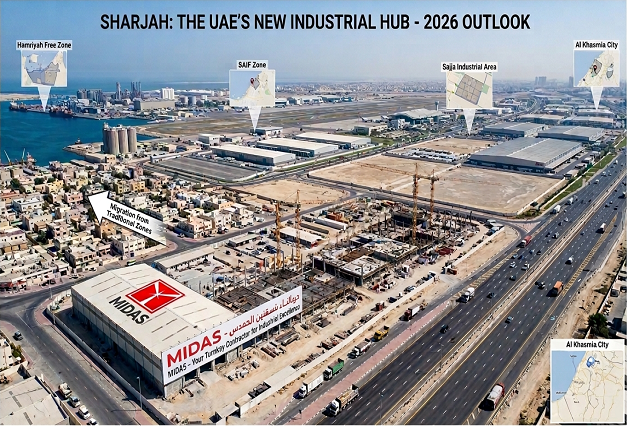
Sharjah has quietly become the industrial hub of the UAE. While Dubai and Abu Dhabi dominate headlines, Sharjah now accounts for around 40% of the UAE’s total industrial establishments — more than 2,800 factories operating across 21 industrial zones, according to figures announced by Invest in Sharjah at Make it in the Emirates 2026. For manufacturers deciding where to build their next facility, the numbers increasingly point to one emirate.
This outlook covers what’s driving Sharjah’s industrial growth in 2026, what each major zone offers, and what it means practically if you’re planning to build.
Sharjah’s industrial sector by the numbers
The scale of activity is easiest to see in the data presented at Make it in the Emirates 2026 and reported by Gulf News and Entrepreneur Middle East:
- Dh3.51 billion in industrial foreign direct investment across 99 projects over the past five years — with AED 1.6 billion across 31 projects in 2025 alone.
- 532 new industrial licences issued in 2025, up 17% year-on-year, with total licences reaching 3,886.
- Industrial real estate transactions up 88.7% in 2025, reaching AED 9.24 billion — a clear signal of where manufacturers are committing capital.
- Industrial products exported from Sharjah now reach more than 120 countries.
- In April 2026, the Sharjah Economic Development Department introduced a Dh1,000 instant industrial licence — one of the lowest-cost industrial entry points in the UAE.
The momentum has continued into mid-2026: in July, India’s Shyam Steel Group inaugurated its first international manufacturing facility outside India in Hamriyah Free Zone, with an initial AED 60 million investment and a phased roadmap of AED 150 million — a signal, per HFZA’s announcement, of how global industrial groups now view Sharjah as a strategic manufacturing base.
All of this sits within Operation 300bn, the UAE’s national strategy to grow the industrial sector’s GDP contribution from Dh133 billion to Dh300 billion by 2031. Sharjah, with its established factory base and land cost advantage over Dubai, is positioned to capture a disproportionate share of that growth.
The zones: where to build in Sharjah
Sharjah’s 21 industrial zones aren’t interchangeable. The right choice depends on what you’re manufacturing, your logistics profile, and your utility requirements.
The heavyweight. Hamriyah Free Zone hosts heavy industry and petrochemical manufacturing on roughly 26 million square metres, with a 14-metre deep-water port and direct access to global shipping routes. It offers 100% foreign ownership, full profit repatriation and long-term leases — and it’s where much of Sharjah’s oil & gas, steel and lubricants production is concentrated. If your facility needs port access, heavy power loads, or proximity to the petrochemical ecosystem, HFZ is the default answer. We’ve covered the practical side — licences, SEWA power connection, Civil Defence and contractor requirements — in our complete guide to Hamriyah Free Zone factory setup.
Sharjah Airport International Free Zone (SAIF Zone)
Positioned beside Sharjah International Airport, SAIF Zone suits manufacturers with air-freight-dependent supply chains — electronics, precision components, pharmaceuticals, and light manufacturing where speed to market matters more than heavy utilities. Pre-built warehouse units and fast licensing make it one of the quickest zones to become operational in.
Sajja Industrial Area (Al Sajaa Industrial Oasis)
The growth story of 2026. Al Sajaa’s Phase 2 expansion reaches full operational status by Q3 2026, adding approximately 12 million square meters of industrial plots and an estimated 8,000 direct jobs, with a focus on building materials, waste-to-energy and aluminium downstream industries. Land here still undercuts comparable plots in Dubai, and the new Sharjah–Saudi Arabia trade corridor strengthens its logistics case for manufacturers exporting into the GCC by road.
Al Khasmia City
Sharjah’s newest industrial development and one to watch. As announcements continue through 2026 — including a planned Graphene Park revealed at Make it in the Emirates — Al Khasmia is being positioned for advanced and technology-led manufacturing. Early movers typically secure the best plots and rates; we’ll publish a dedicated guide as the zone’s regulations firm up.
What this means if you’re planning to build
Three practical takeaways for manufacturers and investors:
Land and licensing have never been more accessible — but construction capacity is tightening.
With industrial real estate transactions up 88.7% and thousands of new licences issued, contractor demand across Sharjah’s zones is rising. Manufacturers who lock in their design and contractor early avoid the procurement delays that stretched timelines in 2025.
Zone rules shape your build. Each authority has its own requirements: free-zone registered contractors, SEWA approval for electrical works, Civil Defence certification for fire systems, EPDA environmental clearances. Building in Hamriyah Free Zone, for example, requires an HFZA-registered contractor — a step that catches many first-time investors by surprise.
Turnkey delivery reduces the coordination burden.
An EPC contract puts design, procurement and construction under one accountable contractor — which matters more in a multi-authority environment like Sharjah’s, where a single project can involve HFZA, SEWA, Civil Defence and EPDA approvals in sequence.
The Midas Group has been building in Sharjah’s industrial zones since 2003 — factories, warehouses, tank farms and process facilities across Hamriyah Free Zone, SAIF Zone and Sajja. If you’re evaluating a site or planning a facility, our team can advise on zone-specific requirements before you commit. Talk to us about your project.
Frequently asked questions
Hamriyah Free Zone is Sharjah’s largest industrial zone, covering roughly 26 million square metres with a 14-metre deep-water port. It hosts more than 6,500 companies and concentrates the emirate’s heavy industry — petrochemicals, steel, lubricants and oil & gas fabrication — alongside Sajja Industrial Area, which is expanding rapidly through 2026.
Cost, concentration and closing distance. Industrial land and utilities in Sharjah price below comparable Dubai zones, while the emirate hosts around 40% of the UAE’s industrial establishments — over 2,800 factories. And the commute gap is shrinking: Sharjah’s Dh750 million road programme — the Al Taawun tunnel, five new bridges and the Noor Road link into Dubai — begins opening from November 2026, with direct connections to Emirates Road and Sheikh Mohammed bin Zayed Road.
Al Khasmia City is Sharjah’s newest planned industrial development, positioned for advanced manufacturing and technology-led industry. Announcements through 2026 — including a planned Graphene Park — indicate the emirate intends it as a next-generation counterpart to Hamriyah and Sajja. Regulations and plot availability are still being finalised.
Entry costs dropped sharply in 2026: Sharjah’s Economic Development Department now offers a Dh1,000 instant industrial licence, while free-zone packages in Hamriyah start with modest annual licence fees. Total project cost depends chiefly on land lease terms, facility size and specification — construction is typically the largest component, which is why contractor selection matters early.