

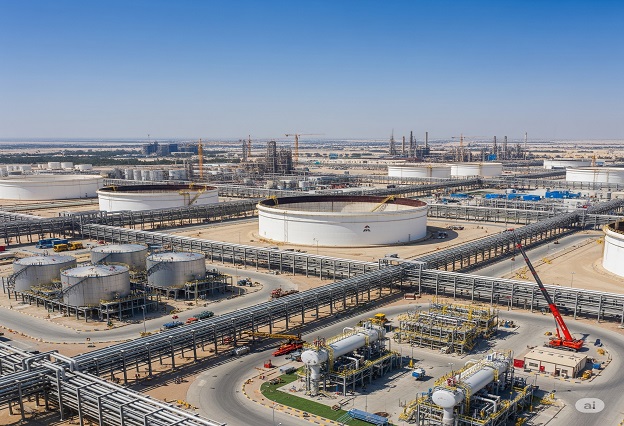
Oil and gas companies in Hamriyah Free Zone operate from one of the most purpose-built energy hubs in the region. The zone’s dedicated oil and gas area spans more than 4.6 million square metres, according to the Hamriyah Free Zone Authority, serving upstream, midstream and downstream operators in a country holding the world’s seventh-largest proven crude reserves.
Having built warehouses, tank farms and storage facilities for energy companies across the zone, we see the same factors drive the decision again and again. Here’s what makes Hamriyah work for oil & gas — and what to know before you commit to a facility there.
Why is Hamriyah’s port critical for oil & gas operations?
Logistics. Hamriyah Free Zone operates a 14-metre deep-water port with approximately 6,600 meters of quay — deep enough for the vessels that move crude, refined products and heavy project cargo. For operators, that means raw materials and equipment arrive beside the facility rather than trucking in from Jebel Ali, and finished product loads out the same way.
The port sits on the Arabian Gulf with direct access to regional shipping lanes, roughly 15 minutes from Sharjah International Airport for crew and urgent freight. And land-side connectivity is improving: the new Sharjah–Saudi Arabia trade corridor strengthens road export routes into the GCC, while Sharjah’s Dh750 million road program (first phase opening November 2026) eases the Dubai connection.
What does the dedicated oil & gas zone offer?
Beyond the standard free-zone package — 100% foreign ownership, full repatriation of capital and profits, and tax-free operations — the oil & gas zone provides:
- Industrial plots configured for energy use: heavy power capacity, deep foundations for tank farms, and separation distances that accommodate hazardous material storage.
- A concentrated energy ecosystem: refiners, lubricant blenders, bunker suppliers, storage operators and oilfield service companies within the same zone — suppliers and customers are neighbours. Recent expansions by operators like Orchid Petrochem’s refinery units signal continuing investment.
- A single regulator: HFZA handles licensing, land leases and building permits under one authority, which shortens the approval chain compared with mainland routes.
What kind of facilities are oil & gas companies building in HFZ?
The proof is in what’s already been built. Recent projects our group has delivered inside the zone show the typical scope:
- A complete industrial complex for Petrochem Global — warehouse, petrochemical tank farm, office block and utility buildings supporting refinery operations.
- A petrochemical storage facility for Energy Fuel International with advanced safety and environmental protection systems.
- Warehouse and auxiliary buildings for Oil and Gas International and a full warehouse-office-yard facility for Sprint Oil and Gas Services.
The pattern across these projects: oil & gas facilities in HFZ are rarely a single building. They combine civil construction, steel and tank fabrication, and specialist MEP — which is why operators increasingly procure them as one turnkey package rather than coordinating three contractors.
What should operators know before building in the zone?
Three practical points from the ground:
Contractor registration matters. Construction inside HFZ requires an HFZA-registered contractor, and fire systems need Sharjah Civil Defence approved installers. Verify both registrations before signing — we cover the full regulatory sequence in our Hamriyah Free Zone factory setup guide.
Tank farms drive the engineering. Storage capacity is usually the commercial heart of an oil & gas facility, and tank design to API standards — foundations, bunding, fire protection — is where specialist steel fabrication and erection capability separates contractors. Process-side scope (piping, metering, safety systems) draws on refinery process technology expertise.
Timelines reward early commitment. With Sharjah’s industrial real estate transactions up 88.7% in 2025 and new entrants like Shyam Steel opening facilities in the zone this year, contractor and plot availability tighten as the zone fills. Operators who engage design and contracting before final plot allocation consistently hit their commissioning dates.
Planning an oil & gas facility in Hamriyah Free Zone? The Midas Group has delivered energy-sector projects in the zone for over two decades — talk to us before you commit to a plot, and we’ll flag the zone-specific requirements that affect your design and budget.
Frequently asked questions
Hamriyah combines a 14-metre deep-water port and roughly 6,600 metres of quay with a dedicated oil & gas zone of more than 4.6 million square metres. Operators get 100% foreign ownership, tax-free operations, heavy-industry plots and an established ecosystem of refiners, storage operators and oilfield service companies in one location.
Yes. The zone’s oil & gas area is configured for refineries, tank farms, blending plants and petrochemical storage, with plots that accommodate hazardous-material separation distances and heavy utility loads. Projects require HFZA building permits, Civil Defence approved fire systems and, typically, tanks engineered to API standards.
Yes — construction inside the zone must be carried out by an HFZA-registered contractor, and fire protection systems require Sharjah Civil Defence approved installers. Confirm both registrations during tendering; an unregistered contractor cannot obtain the building permits your project needs.
The zone sits roughly 30–40 minutes from Dubai by road, 15 minutes from Sharjah International Airport. Connectivity is improving through 2026: Sharjah’s Dh750 million road program into Dubai begins opening in November 2026, and the new Sharjah–Saudi trade corridor strengthens GCC road export routes.